HorizonMath

Measuring AI Progress Toward Mathematical Discovery with Automatic Verification

1Stanford University   2Benchmark   3University of Oxford   4Harvard University   5Princeton University   6Ellison Institute of Technology

*Joint-first authors. Correspondence: erikwang@stanford.edu and sumeet.motwani@eng.ox.ac.uk.

Overview

Can AI make progress on important, unsolved mathematical problems? We introduce HorizonMath, a benchmark of 113 predominantly unsolved problems across eight domains in mathematics and the mathematical sciences, paired with an open-source evaluation framework. It targets the generator-verifier gap: problems where discovery requires mathematical insight, but candidate answers can be checked by straightforward computation. Unknown solutions make the benchmark resistant to data contamination. Across nine model configurations from seven frontier model families, most score below 10%. We report six distinct research discoveries: GPT-5.4 Pro finds three, and GPT-5.6 Sol Max reproduces these and finds three additional solutions. HorizonMath is an open challenge and growing community resource, where each verified solution is a candidate contribution to the mathematical literature.

Benchmark Overview

The August 2026 paper evaluates a snapshot of 113 problems: 10 solved calibration problems and 103 problems in the unsolved tiers at benchmark assembly. The public dataset continues to grow beyond this evaluated snapshot.

113 Problems
8 Domains
103 Unsolved-tier problems
3 Eval Modes

Solvability Levels

LevelDescriptionCount
0Calibration (solved)10
1Likely solvable29
2Challenging66
3Likely unsolvable8

Mathematical Domains

DomainCount
Number Theory20
Special Functions19
Statistical Mechanics15
Discrete Geometry15
Combinatorics13
Spectral Theory12
Continuum Physics10
Coding Theory9

Key Results

Six distinct discoveries across the unsolved tiers. GPT-5.6 Sol Max leads with 13 accepted solutions out of 113 problems (11.5%), including seven calibration problems and six unsolved-tier problems.
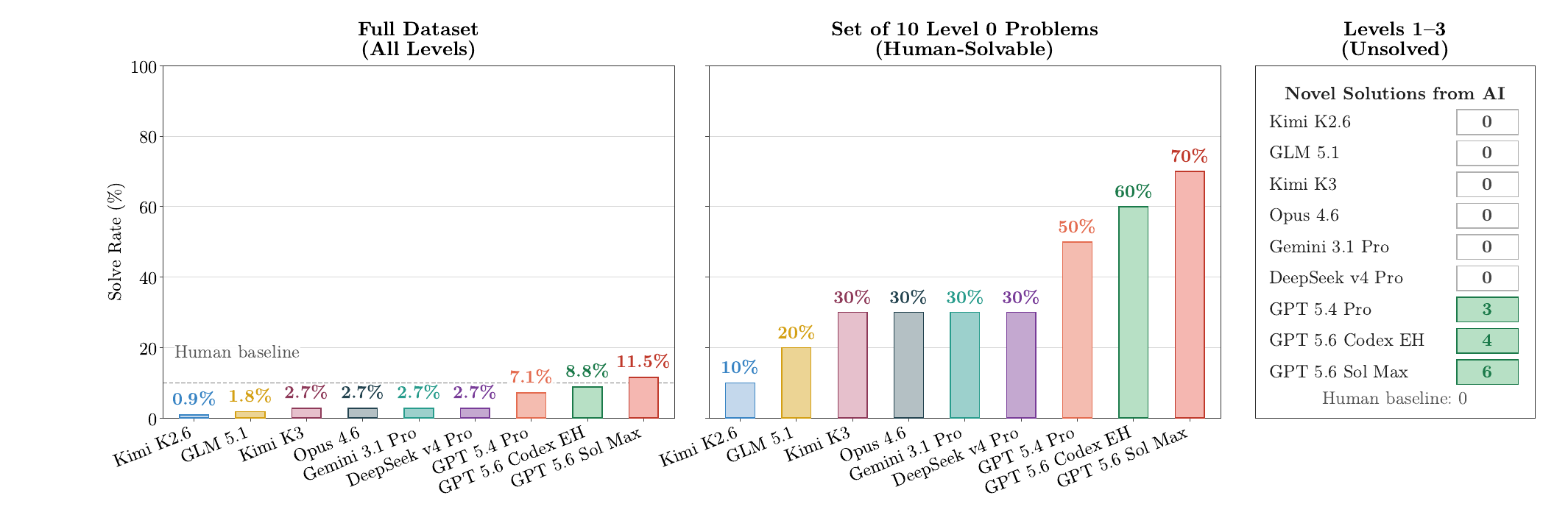
Figure 4 from the paper: solve rates across nine model configurations on all 113 problems, the ten calibration problems, and the unsolved tiers. GPT-5.6 Sol Max leads at 11.5% overall, 70% on calibration, and six unsolved-tier solutions. Full values are available in the results table below.
Figure 4. Model performance on HorizonMath: the full benchmark (left), ten calibration problems (center), and accepted solutions on the unsolved tiers (right). Select the figure to view it at full resolution.
View results as a table
August 2026 draft · Figure 4 · 113-problem evaluation snapshot
Model / configurationFull datasetCalibrationUnsolved-tier solutions
GPT-5.6 Sol Max13/113 (11.5%)7/10 (70%)6
GPT-5.6 Sol xhigh (Codex)10/113 (8.8%)6/10 (60%)4
GPT-5.4 Pro8/113 (7.1%)5/10 (50%)3
Claude Opus 4.63/113 (2.7%)3/10 (30%)0
Gemini 3.1 Pro3/113 (2.7%)3/10 (30%)0
DeepSeek V4 Pro3/113 (2.7%)3/10 (30%)0
Kimi K33/113 (2.7%)3/10 (30%)0
GLM 5.12/113 (1.8%)2/10 (20%)0
Kimi K2.61/113 (0.9%)1/10 (10%)0

Evaluations use pass@1. For GPT-5.4 Pro problems with a verified first-attempt solution, one additional query explored further improvements. Counts in the last column overlap across models; they represent six distinct problems, not thirteen separate discoveries.

Bound improvement

Diagonal Ramsey Numbers

Improves the exponential base in R(k,k) \le c^{k+o(k)} from approximately 3.7992 to 3.6961, a 2.71% reduction, using a quintic correction and a verified certificate in the Gupta–Ndiaye–Norin–Wei framework.

Bound improvement

Thin-Triangle Kakeya (128 slopes)

Reduces union area from approximately 0.1148103 to 0.1091480, a 4.93% improvement over the AlphaEvolve baseline. A deterministic piecewise-linear area calculation validates the construction.

Closed-form discovery

Spinor Norm Elliptic Integral

Expresses the integral in terms of gamma values at one quarter and three quarters. The expression matches the numerical reference to 140 digits. This is the third result found by GPT-5.4 Pro and reproduced by GPT-5.6 Sol Max.

Closed-form candidate

Fifth Moment of the Airy Function

GPT-5.6 Sol Max proposes a symbolic expression for a_5 that passes the compliance check and matches the high-precision reference for this Level 2 problem.

Closed-form candidate

Equal-Power TE+TM Spherical-Mode Quality Factor

One of three additional Level 2 results from GPT-5.6 Sol Max: a symbolic expression that passes the compliance check and matches the high-precision reference.

Closed-form candidate

Non-Resonant TM/TE Spherical-Mode Quality Factor

GPT-5.6 Sol Max also produces an admissible symbolic expression for this Level 2 problem, matching the corresponding high-precision reference.

How Verification Works

Models submit self-contained Python functions. The framework executes candidates in a sandbox, checks correctness, and uses an LLM-based compliance checker to screen for forbidden operations.

Closed forms

Compare an admissible symbolic expression against a high-precision reference to \min(20,D) decimal digits, where D is the number of verified reference digits.

Bound improvements

Check a construction with a problem-specific validator and require strict improvement over the published baseline.

New constructions

Check every required property of a proposed object deterministically, with pass/fail scoring and no baseline comparison.

Closed-form answers must use finite expressions built from permitted constants and functions. Numerical quadrature, root-finding, infinite series, and fitted numerical constants are disallowed. The compliance checker is imperfect, so automated evaluation reduces the need for expert review without replacing it.

Example Problems

These examples from Section 5 of the draft cover all three evaluation modes: closed-form discovery, bound improvement, and new construction.

Special FunctionsSolvability 1Closed form

Spinor Norm Elliptic Integral (I_0)

Let K(m) and E(m) be complete elliptic integrals in the parameter convention. Find a closed-form expression for:

I_0 = \frac{4\sqrt{2}}{\pi}\int_0^1 \frac{1+\sqrt{z}}{(1+z)^3}\left(2E(z)-(1-z)K(z)\right)\,dz

The value is approximately 1.77425\ldots. Answers must use permitted symbolic operations without quadrature, infinite series, root-finding, or hard-coded numerical approximations. The draft reports a discovered expression for this benchmark problem.

Show expected output format
def proposed_solution():
    from mpmath import mp
    mp.dps = 100
    result = ...  # finite symbolic expression
    return result
Construction Solvability 1 Bound improvement

Minimum-Scope Difference Triangle Set (7,5)

Shehadeh, M., Kingsford, W., & Kschischang, F. R. (2026). New Difference Triangle Sets by an FPGA-Based Search Technique. J. Combin. Des., 34(1).

An (n,k)-DTS is an n \times (k+1) array A with entries a_{i,j} such that each row is strictly increasing and normalized:

0 = a_{i,0} < a_{i,1} < \cdots < a_{i,k}

Define the set of positive within-row differences:

D = \{ a_{i,j} - a_{i,j'} : \text{for all } i, \text{ and } 0 \le j' < j \le k \}

All elements of D must be distinct. The scope is m(A) = \max_{i,j} a_{i,j}. Task: Find a valid (7,5)-DTS with scope strictly less than the current best-known upper bound m(7,5) \le 112.

Show expected output format
def proposed_solution():
    return {
        "n": 7, "k": 5,
        "rows": [
            [0, a01, a02, a03, a04, a05],
            ...  # 7 rows total
        ]
    }
Coding TheorySolvability 1New construction

Three Mutually Orthogonal Latin Squares of Order 10

Construct three 10\times10 Latin squares over \{0,1,\ldots,9\}, with each symbol appearing exactly once in every row and column. Every pair of squares must contain each of the 100 ordered pairs exactly once when superimposed.

The validator checks the Latin-square conditions and all three pairwise orthogonality conditions exactly.

Show expected output format
def proposed_solution():
    # Each L is a 10-by-10 integer array with entries 0 through 9.
    return {"squares": [L1, L2, L3]}

Comparison with Existing Benchmarks

Comparison as reported in Table 1 of the August 2026 draft.

Dataset Problems Unsolved Open Eval Auto-Verify
FrontierMath300+
FrontierMath: Open Problems14
IMProofBench39
First Proof10
Erdős Problems1,000+
IMO-AnswerBench400
Optimization Constants96
HorizonMath113

BibTeX

@article{wang2026horizonmathmeasuringaiprogress,
      title={HorizonMath: Measuring AI Progress Toward Mathematical Discovery with Automatic Verification},
      author={Erik Y. Wang and Sumeet Ramesh Motwani and James V. Roggeveen and Eliot Hodges and Dulhan Jayalath and Charles London and Kalyan Ramakrishnan and Cheng Zhang and Flaviu Cipcigan and Philip Torr and Alessandro Abate},
      year={2026},
      eprint={2603.15617},
      archivePrefix={arXiv},
      primaryClass={cs.LG},
      url={https://arxiv.org/abs/2603.15617},
}